Sep 17, 2025
Quest One manufactures electrolyzers in series production in Germany – through the collaboration of two sites in Augsburg and Hamburg. The company pursues its mission to make green hydrogen available on an industrial scale using innovative technologies and products, thereby playing a key role in shaping the hydrogen economy.
The series production of high-performance stacks and electrolyzers is central to this mission – and presents both technological and industrial challenges. Our Gigahub in Hamburg focuses on research, development, and automated production of electrolyzer stacks. In the Augsburg facility, these stacks are assembled, integrated, and undergo final testing to become complete electrolyzers.
Quest One specializes in PEM electrolysis, which is based on Proton Exchange Membrane (PEM) technology. It is one of the most important methods for industrial-scale hydrogen production from renewable energy sources. As an electrolyzer manufacturer, Quest One aims to help avoid one percent of global greenhouse gas emissions by 2050 with its innovative electrolyzers.
The two facilities are closely interconnected and together form Quest One’s industrial value chain. They also collaborate intensively in areas such as order management, logistics, technical feedback loops regarding Design for Manufacturing, prototype testing, and development projects. What unites the teams in Hamburg and Augsburg – beyond the 1% goal – is a shared industrial mindset, shaped by the backgrounds of many employees in the automotive and plant engineering sectors. This means that Quest One integrates experience from mass production, process optimization, and quality management directly into the development and manufacturing of its electrolyzers.
Tradition Meets Innovation: Focus on the Augsburg Production Site
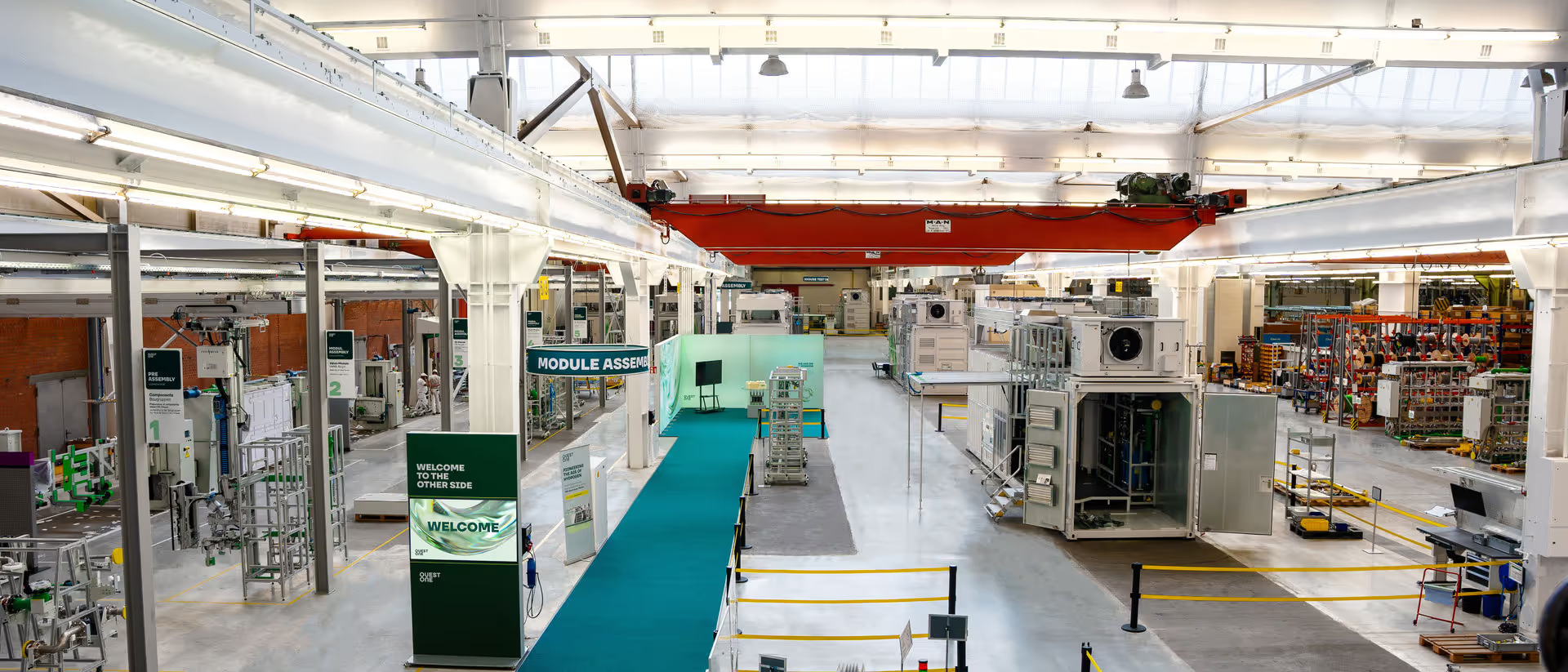
Augsburg in Bavaria is both the headquarters and the largest Quest One site. The modern working, development, and production environment spans several buildings. On approximately 10,000 square meters of production space, historic factory halls meet industrial efficiency and technological scalability. The focus is always on producing innovative electrolyzers with excellent quality and maximum flexibility at an industrial scale.
In Augsburg, the final assembly and system integration of the electrolyzers take place, incorporating the stacks produced in Hamburg. Manufacturing follows several clearly defined process stages: pre-assembly, preliminary assembly, module assembly, final assembly, and testing.
Structured Production for Dynamic Markets
Site Manager Claudio Bravo Granadino draws on proven concepts from the automotive industry, such as lean manufacturing and one-piece flow, and adapts them to the needs of the electrolysis industry. His goal is to build a facility that can grow with the market – technically, in terms of personnel, and structurally.
“Our task is to deliver electrolyzers on time, in top quality, and in the right volume. To achieve this, we rely on a flexible, modular production system and a just-in-time supply chain –so we can scale from our 1MW electrolyzer ME450 to our large-scale MHP plant at any time. We build structures that are not based on rigid lines, but on what the market demands from us,” says Bravo.
The production philosophy in Augsburg does not rely on full automation. Instead, manually supported, digitally secured processes dominate, complemented by semi-automated assembly aids and data-driven production control. This type of production allows for rapid response to technical advancements without costly adjustments to fully automated systems and enables short-term adaptation of production capacities to market developments. By expanding to a two-shift operation, the facility could potentially deliver up to 400 megawatts annually without fundamental structural changes.
Module Assembly as a Core Process in Augsburg
Quest One’s PEM electrolyzer consists of three main modules, which are pre-assembled and mounted at the Augsburg site:
- Stack Module: Houses the stack and its peripherals – where the electrolysis process occurs
- Valve Module: Control unit with all safety-relevant connections and valves
- Water Module: Component for internal water treatment and management
Each electrolyzer contains more than 1,500 individual components. During final assembly, the pre-assembled modules are integrated into a prepared container, along with other key components such as ion exchangers, rectifiers, and the power supply system. The system is then tested before the finished unit is delivered.
Quality Assurance with Four Control Points
Product quality is ensured through a multi-stage inspection concept:
- Quality check of all supplied components
- Module testing after module assembly
- System testing after final assembly
- End-of-line test including leak and functionality checks
In what is known as the Inhouse Test Cold, each unit is operated for two weeks in an internal test environment. Digital work assistance systems and data analytics ensure complete traceability of all installed components. The goal is a zero defect rate.
“Our standard is clearly defined: No faulty system may leave our facility.”
— Claudio Bravo Granadino, Site Manager Quest One Augsburg & Vice President Operations Electrolyzer
Integration of Development, Production, and Testing
The site is home not only to production and logistics teams but also to development engineers, testing specialists, and the ramp-up team for prototyping and new manufacturing projects. Their close collaboration enables the rapid integration of new product generations, such as the upcoming 10-megawatt MHP (Modular Hydrogen Platform). In parallel, a demonstration plant of the MHP with five megawatts of output is being built on the neighboring Everllence (formerly MAN Energy Solutions) site. It serves as an important test environment for Quest One’s MHP, designed for industrial and large-scale project applications.
Perspectives for Hydrogen Scale-Up
Augsburg is prepared for growth, technologically, organizationally, and in personnel. With the implementation of the “Production System as a Competitive Advantage,” the team aims to respond to market ramp-up in a scalable way without compromising on quality or efficiency.
For workforce development, the team relies on shared values and a healthy generational mix that enables new innovation. In close cooperation with universities, Fraunhofer Institutes, and other educational institutions, the facility continuously develops its human resources. The combination of vocational training, internships, academic collaboration, and targeted upskilling of the existing workforce ensures sustainable talent development for green future technologies.