
Mobility and Refueling
Hydrogen infrastructure and fleet projects need technology that can be deployed fast, run flexibly, and scale with demand. Quest One enables fast deployment of flexible PEM technology at the required scale.
With scalable PEM electrolyzers and a delivery setup built for rollout, mobility projects can stay on schedule, improve economics, and handle grid and infrastructure constraints in real-world conditions.

What matters most
Keeping Rollouts on Track
Mobility projects are won on execution. Deadlines, cost per kilogram, and site constraints all matter. Hydrogen production needs to be deployable, efficient, and able to respond whenrenewable power supply fluctuates.

Fast deployment to meet deadlines
When rollout windows are tight, equipment needs to be ready to ship and the supply chain needs to deliver at pace.

Economics that work in operation
Efficiency and the right system design directly shape operating costs. The setup should support economic performance from day one.

Built for grid and site constraints
Grid connection and infrastructure limits are real. Solutions need to be designed around these constraints, not around ideal conditions.
Solutions
What we Deliver for Mobility Projects
Scalable electrolysis plus the practical levers that make rollout and operation easier: delivery capacity, efficient products, and flexible operation with renewables.

Delivery capacity and supply chain strength
When rollout windows are tight, equipment needs to be ready to ship and the supply chain needs to deliver at pace.
High-efficiency MHP with pressurized output
Designed to support economic hydrogen production – our high-efficiency MHP systems, including pressurized output for mobility use cases.

Flexible operation with renewables
Options for direct connection to renewable energy sources, enabling flexible operation and fast response to fluctuations in supply.
Why Quest One
Proven Technology, Ready to Perform
Mobility rollouts depend on readiness and repeatability. Quest One brings together delivery capacity, operational learnings, and comparable projects that support planning and rollout decisions.
Delivery readiness at scale
Strong production capacity and a stable supply chain help keep mobility projects on schedule and support faster rollout.

Performance that holds up in operation
Testing, field data, and operating experience create a realistic basis for performance, efficiency, and daily operation.

Decades of experience
Many successful projects show that Quest One is the right partner for planning, rollout, and scaling.
Quest One key figures
Facts Make a Difference
Quest One technology is already being used in hydrogen mobility and refueling projects – from public transport to island infrastructure. These figures show what the technology delivers and where it is already being deployed.
High-purity hydrogen per day from one ME450
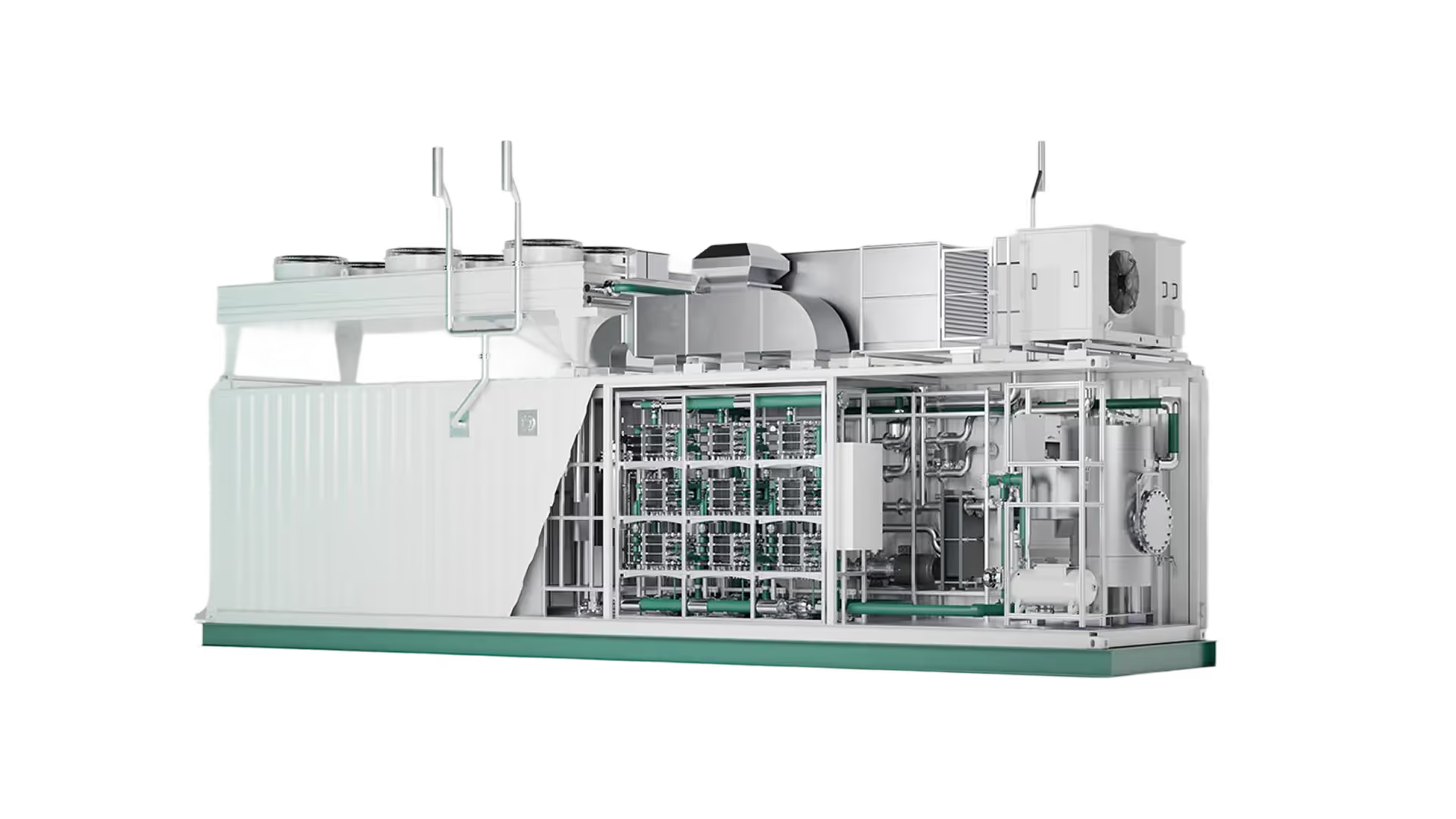
Each Quest One ME450 has an electrolysis capacity of 1 MW and can produce 450 kg of high-purity hydrogen per day.
Daily refueling potential per 10 MW MHP
Based on 4,600 kg H₂/day and typical tank capacities for hydrogen buses and heavy-duty trucks. Actual values depend on vehicle configuration.
Supplied for RVK’s hydrogen mobility project
Quest One is supplying two ME450 electrolyzers for RVK’s project in Mechernich, supporting hydrogen mobility infrastructure for public transport.



Frequently Asked Questions
Fuel cell electric vehicles (FCEVs) including buses, trucks, trains,forklifts, and passenger cars can all be fueled using hydrogen generatedon-site by PEM electrolyzers.
Yes. On-site PEM electrolysis is often the most cost-effective and logistically simple model for hydrogen refueling stations, eliminating transport and storage supply chain complexity.
Our systems deliver hydrogen at 30 bar pressure which is compatible with standard refuelling station compression and dispenser equipment, supporting both 350 and 700 bar vehicle tank filling.
At sufficient utilization rates, on-site production generally reaches cost parity or better versus delivered hydrogen, while also eliminating supplychain dependencies and price volatility.
Yes. PEM technology is well-suited to dynamic and intermittent operation, allowing the system to ramp up during high-demand periods and store hydrogen for peak dispensing.
Our systems comply with all relevant EU directives and international standards applicable to hydrogen equipment in transport and refueling.